
 Back
Back


Epiphany Church at Gutuevsky Island

Dvinskaya ul., 2
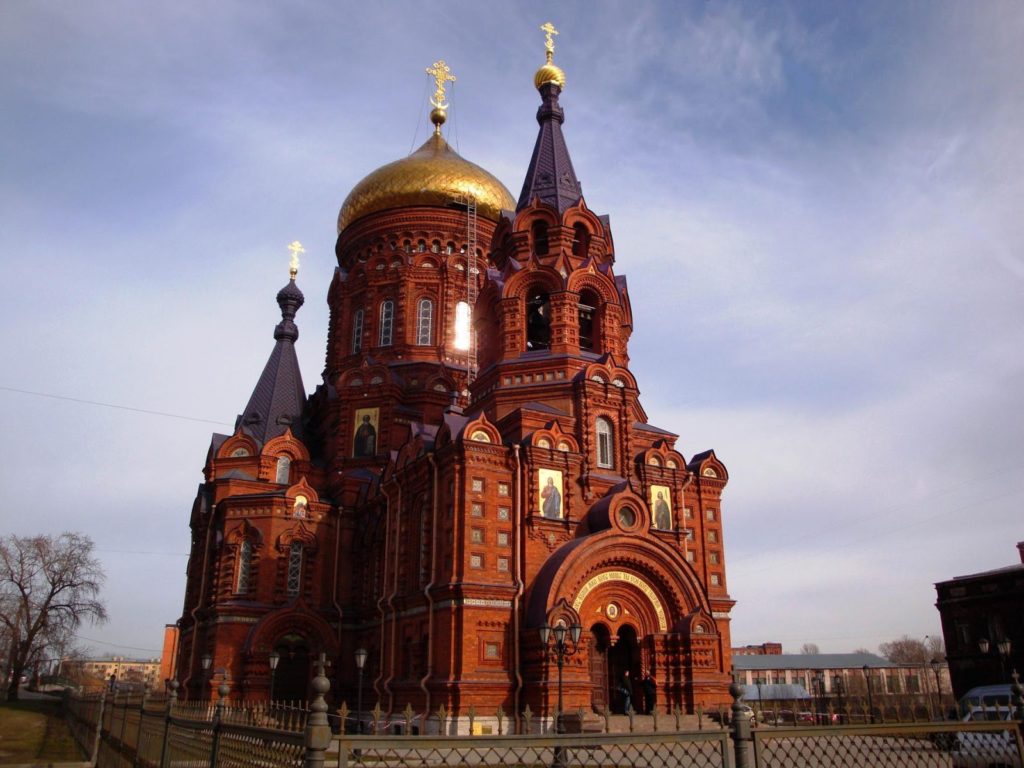
On the vast island of the Neva delta, Gutuevsky, located in the western part of St. Petersburg and washed by the Bolshaya Neva and its branch, the Yekateringofka River, on the right bank rises the Church of the Epiphany of the Lord. The church was built in memory of the miraculous salvation of Tsarevich Nikolai (the future holy passion-bearer Tsar Nicholas II). On April 29, 1891, during the passage of the Heir to the Tsarevich through the city of Otsu in Japan, he was wounded. On the first anniversary of the assassination attempt on the Tsarevich, with the blessing of Metropolitan Isidore /Nikolsky/, the foundation of the church was laid. Architect - V.A. Kosyakov.
On April 29, 1899, the main aisle of the church was consecrated. The rite of consecration was performed by Metropolitan Anthony /Vadkovsky/, and Saint Righteous John of Kronstadt prayed among the priests serving with him. In May 1899, the left aisle was consecrated in honor of Saint Nicholas the Wonderworker, and on July 18, 1899, the right aisle was consecrated in honor of Saint John the Faster.
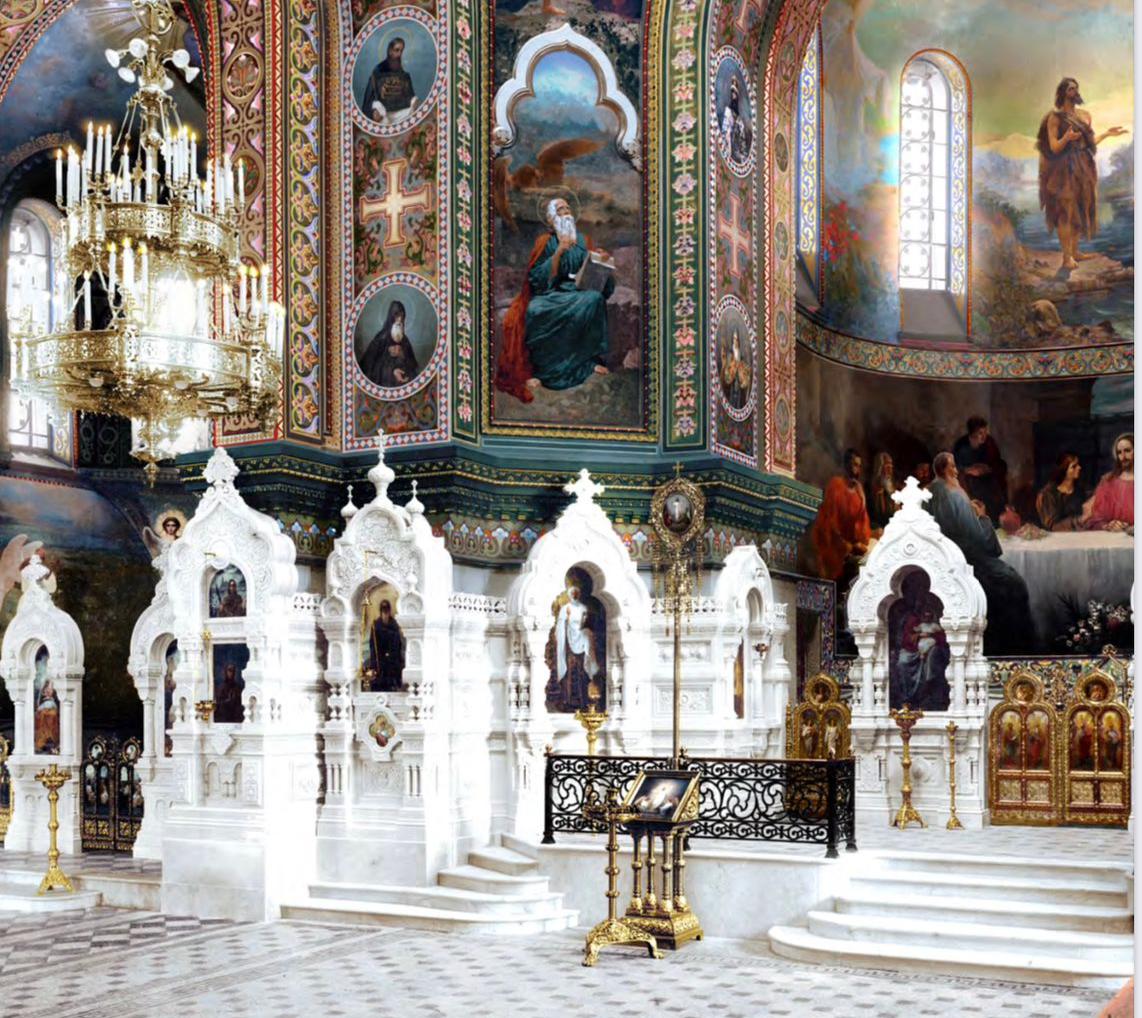
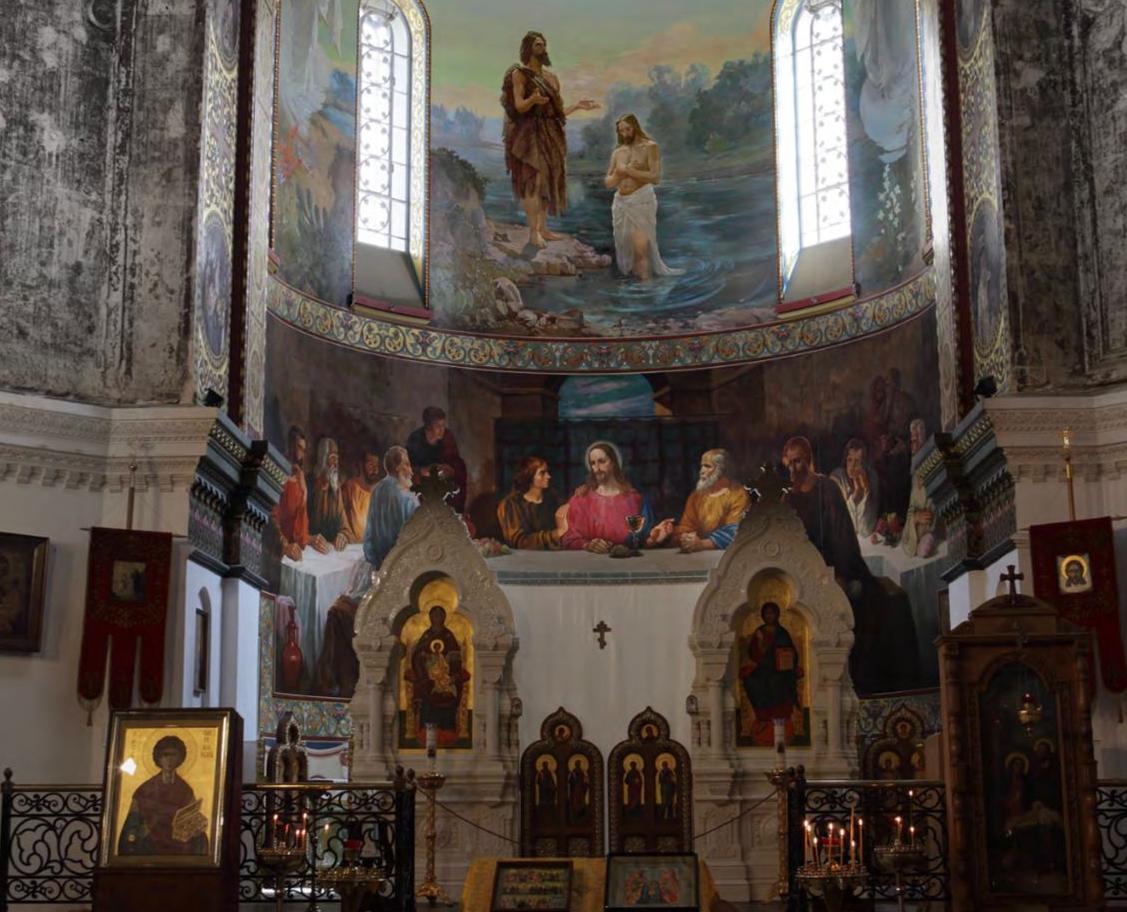
The three-altar church of the Epiphany can accommodate up to 700 people. The altar part was separated by a single-tier iconostasis, made of faience at the famous porcelain factory of M.S. Kuznetsov, and was awarded an award at the World Exhibition in Paris in 1900. The altarpiece of the Last Supper, painted on the entire altar wall, is visible from any place in the church. Above the Last Supper, the icon of the Baptism of the Lord, the banks of the Jordan and the surrounding landscape depicted on it were painted by A.S. Slantsev from life, for which he specially went to Palestine.
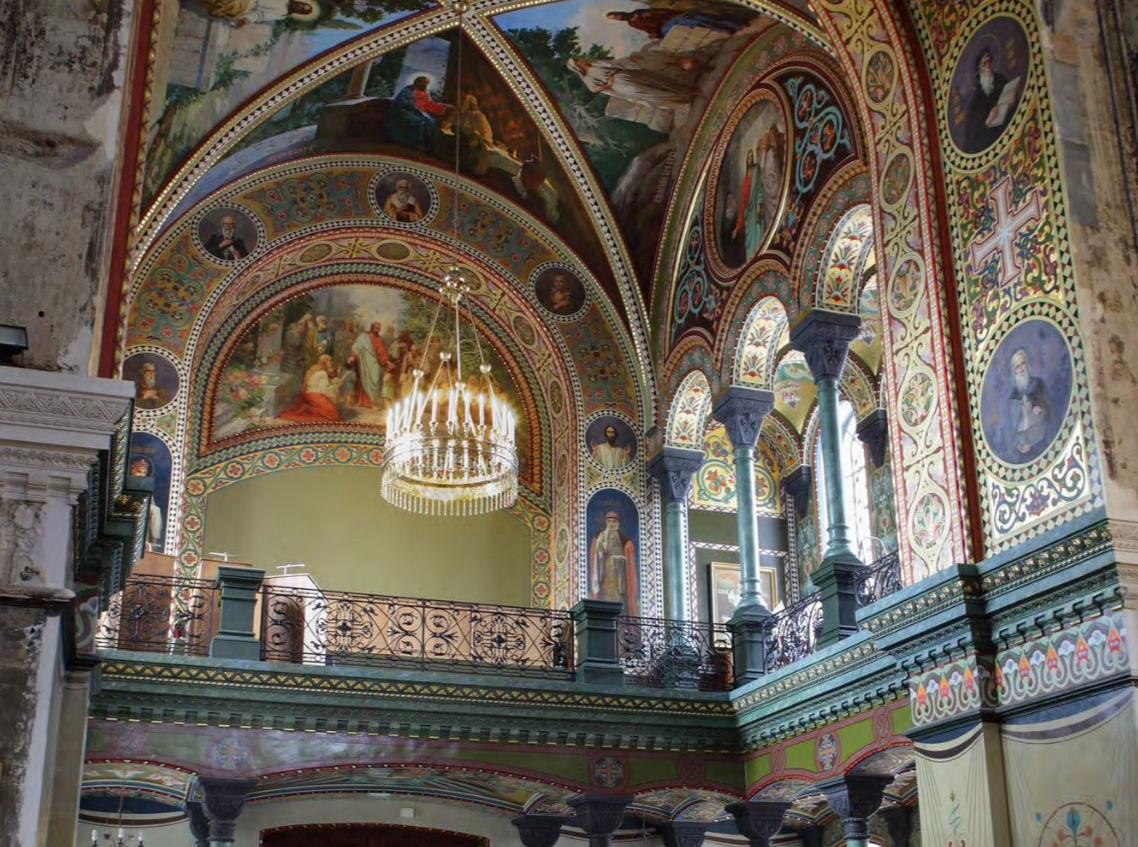
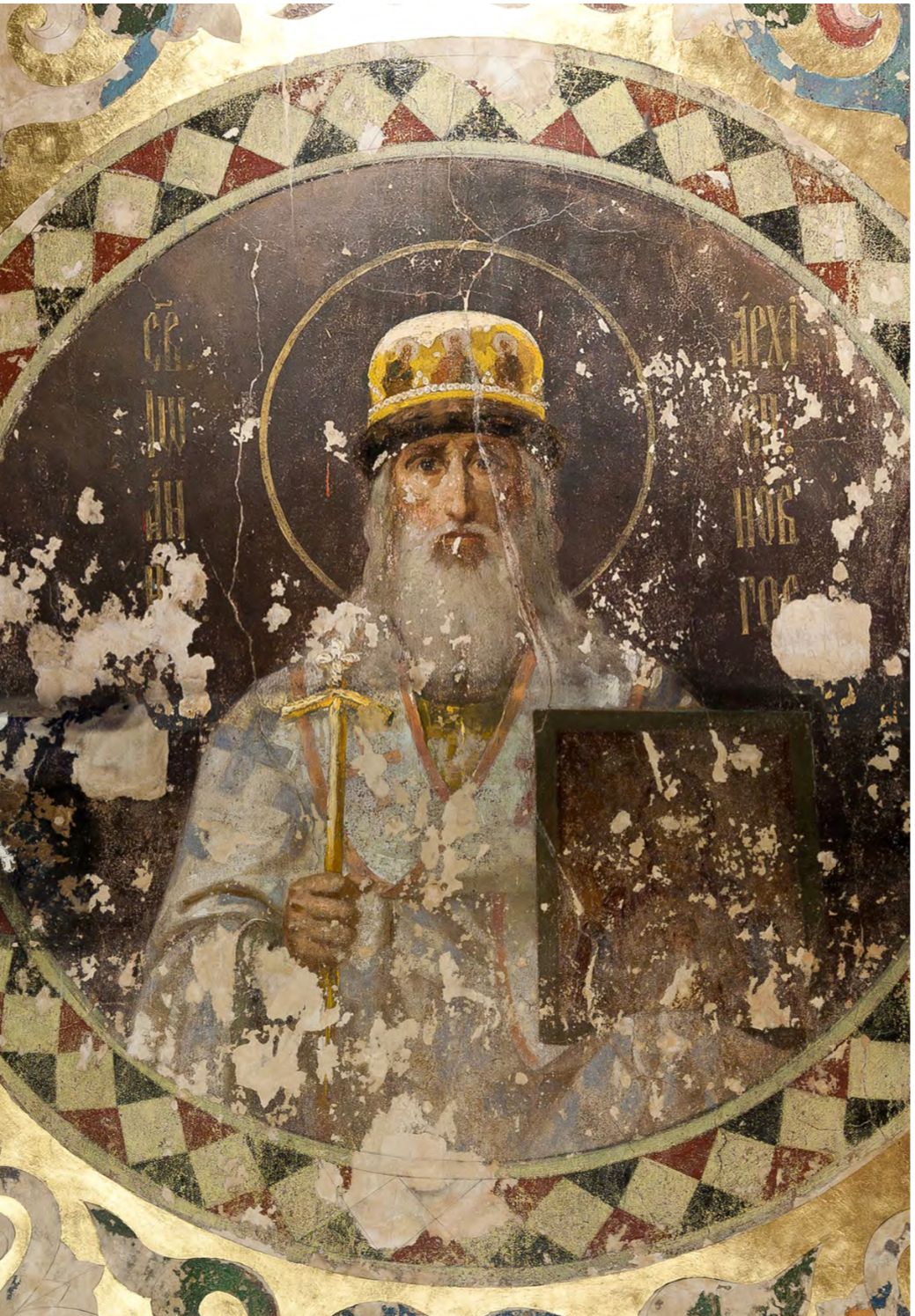
In the main dome of the drum, at a height of more than 30 meters, the image of the Savior is painted. In the lower part of the drum, there was an arcature-columnar belt, the intercolumnia of which were filled with 32 icons - forefathers, prophets and apostles. The wall painting of the temple was done by A.S. Slavtsev, the ornamental painting - K.N. Butakov, the icons in the icon cases and the drum were painted by A.M. Postnikov.
A unique system of electrical equipment for 450 bulbs was developed to illuminate the building. The interior of the temple was illuminated by three bronze gilded chandeliers of highly artistic work.
During the Soviet years, starting in 1935, the Church was closed, the faience iconostasis, icons, and church utensils were lost. The building of the church was used as a vegetable warehouse, a soap factory, and a warehouse for the Frunzensky Department Store.
On January 4, 1991, the Orthodox Community of the Church of the Epiphany on Gutuevsky Island was registered. On April 19, 1991, the Church of the Epiphany was taken under state protection as a historical and cultural monument. By order of the Mayor of St. Petersburg No. 99-r on November 12, 1991, the Church was transferred to the Orthodox Community. On January 19, 1992, on the patronal feast of the Epiphany, the Great Blessing of Water took place in the church. Regular services began to be held in March 1992.
The restoration of the church parish life and the restoration of the shrine are the two main tasks facing the Parish Council of the Church of the Epiphany of the Lord.
The continuation of expensive repair and restoration work, both before and now, mainly depends on the charitable assistance of those organizations, firms and individuals who care not only about their daily bread, but also about the spiritual future of Russia.
On March 14, 1998, a miracle of the renewal of the icon of the Nativity of Christ was witnessed in the church. The previously dark icon began to shine with renewed colors and gilding, as after careful restoration. However, a layer of dust and soot, streaks of lamp oil and frozen drops of wax, revealed on the surface of the icon during inspection, testified to the fact that the hand of a restorer had not touched it. A special diocesan commission witnessed this miracle.
The picturesque decoration of the church is very original and unique in its own way. The walls are completely covered with painting. On the one hand, this is a traditional technique for Old Russian art with division into gospel stories and depiction of saints in various geometric shapes, connected by developed ornamental motifs. On the other hand, the plot compositions are painted in a realistic, volumetric-spatial manner, being practically multi-figure paintings.
It can be said that the painting of the temple, located in the context of the artistic achievements of its time, is revolutionary in certain aspects. The gospel stories are executed according to the laws of constructing a historical painting, but with the obvious influence of the emerging "Russian impressionism". In the manner of A. S. Slavtsev, who, following the example of Alexander Ivanov, traveled to Palestine and painted from life the banks of the Jordan during the spring flowering, a passion for plein air painting can be traced. All this is organically combined with developed ornamental decor, which includes images of Seraphim in the spirit of the "Art Nouveau" style.
The author was undoubtedly influenced by contemporary artists. For example, in the plot of "The Appearance of the Resurrected Christ at the Sea of Tiberias", compositionally reminiscent of Surikov's "The Conquest of Siberia by Yermak", the pictorial achievements of the Impressionists are simultaneously traced, and in the altar painting "The Last Supper" Nikolai Ge's findings in his biblical paintings are used.
Above the choir on the western wall of the temple is the composition "Blessing of the Children", very interesting in the transmission of the light and air environment, as well as "The Child Jesus in the Temple" on the northern wall, which did not escape the influence of Vasily Polenov.
The creative legacy of A. S. Slavtsev is little known and completely unstudied. The painting of the Epiphany Church is perhaps the main and only major work of this talented artist. It is all the more important to preserve and recreate this unique monument of monumental art as carefully as possible.
The Epiphany Church is the second independent building of Vasily Kosyakov. In the first, built
