
 Back
Back

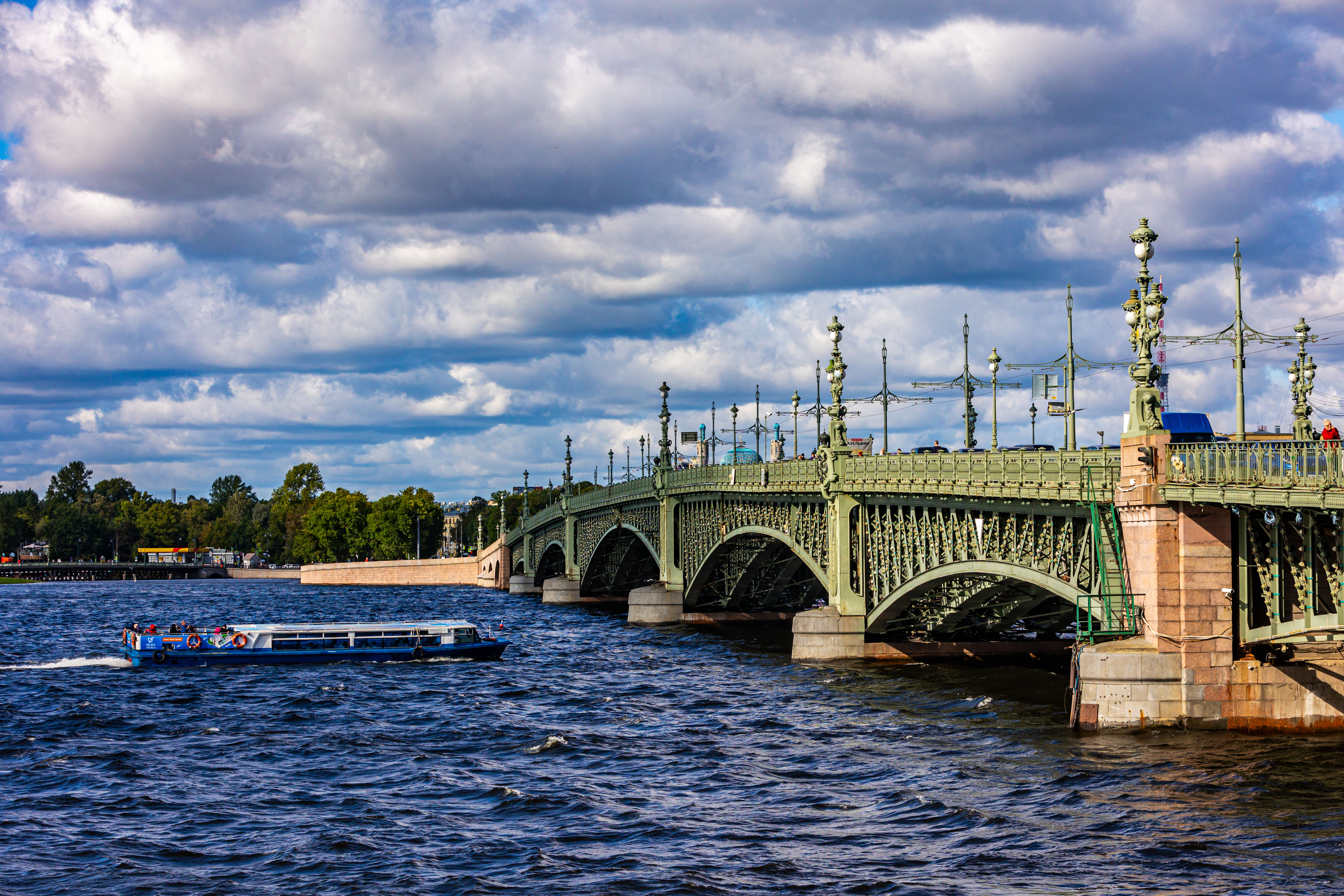
Trinity Bridge

Troitsky most

 Listen
  Download
 Trinity Bridge connects Kamennoostrovsky Prospect with Suvorovskaya Square
The bridge was built after the construction of the Blagoveshchensky and Liteiny bridges. It connects the Field of Mars and Suvorovskaya Square with the Petrograd side - Kamennoostrovsky Prospekt and Troitskaya Square.
The history of crossings in this area of the Neva dates back to 1803, when the old pontoon bridge, called the Petersburg Bridge, was moved to the Summer Garden. In 1824, after the final design of Suvorovskaya Square, construction of a new bridge began. Large-scale work was carried out under the supervision of engineer Major Lebedev. Granite facing of the canals surrounding the nearby Mikhailovsky Castle was used in the design of the stone embankment. A long dam was built on the opposite bank of the Neva, forming an approach to the bridge. Initially, it was supposed to be called Suvorovsky Bridge, since it started from the square of the same name, decorated with a monument to the great commander, but later it was called Troitsky - after the Trinity Church, now lost, towering on the Petrograd side in the center of today's Troitskaya Square.
This bridge served faithfully for 70 years, after which it was decided to build a permanent crossing. The design competition was won by G. Eiffel's company, which was awarded a prize of 6,000 rubles, but the construction was entrusted to the French company "Batignolles", whose project was not considered in the first competition, but was recognized as the best for aesthetic and economic reasons during the second competition initiated by the City Duma.
The new crossing was ceremonially opened on May 16, 1903, as part of the celebration of the bicentennial of St. Petersburg. Nicholas II was present at the opening. The bridge was built in the Art Nouveau style - the obelisk at the entrance and elegant lamps harmoniously combined with the openwork contours of the fences and supports. The new bridge was equipped with a rotating drawbridge, that is, one of its spans rotated around the center of gravity in a horizontal plane, opening 2 fairways for ships passing under it. Only during the reconstruction of 1965-1967 was the rotating mechanism replaced with a span mechanism more familiar to St. Petersburg.
During the Soviet era, the Trinity Bridge underwent significant changes. From 1918 to 1934, it was called the Equality Bridge, and from 1934 to 1991 - the Kirov Bridge. The imperial eagles crowning the obelisks located on the approach to the bridge from Suvorovskaya Square were replaced with stars and Soviet coats of arms. In 2005, the historical appearance of the bridge was recreated.
The length of the bridge is 582 meters, its width is 24 meters.
